
The School Lunch Form Decides Who Pays for Lunch, and the Count It Creates Follows Your Child Past the Cafeteria
One household form sorts kids into free, reduced-price and full-price meals under lines the U.S. Department of Agriculture publishes each year — and the eligibility count behind it also gates fee help and summer grocery benefits, so your district chases the form every fall.
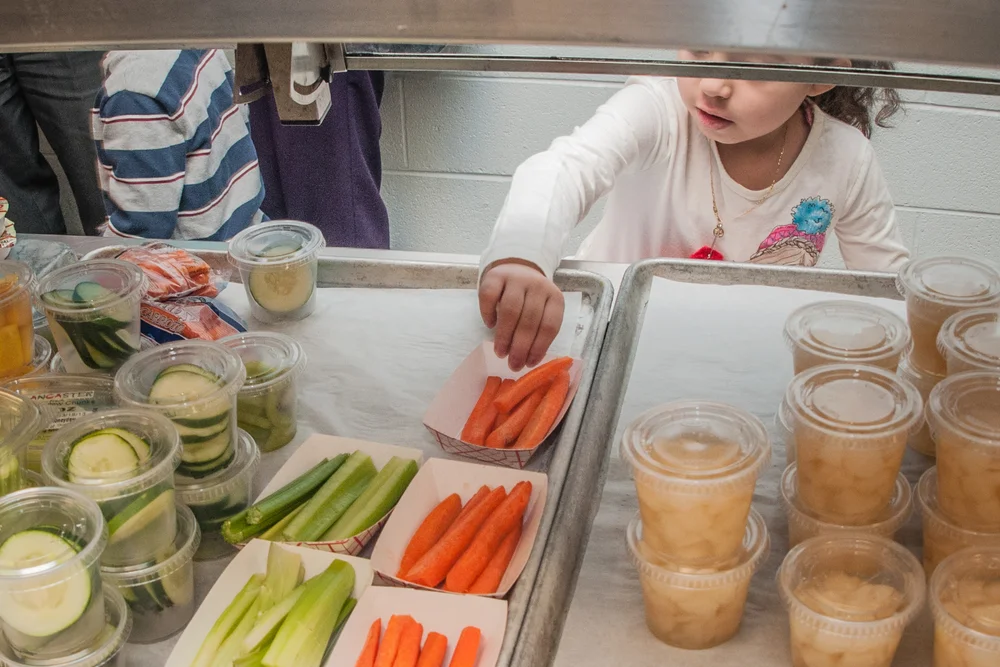
The form arrives folded into the same pile as the emergency contact card, the photo release and the bus form, usually on a night when dinner's already late and somebody can't find a pen that works. It's one sheet, front and back, asking for things a parent doesn't keep in one place: every kid's name, every adult in the house, what each adult earns and how often, and a signature. Here's the part the pile hides: that one sheet runs a federal program, sets the price your kid pays at the register, and creates a count your school carries into rooms your kid never enters. Our earlier look at the family ledger put child care at $13,128 a year on Child Care Aware of America's count, as the Mother Lode's reporting on that figure laid out.
One Form, Four Moves
The application belongs to the National School Lunch Program and the School Breakfast Program, the federally assisted meal programs the U.S. Department of Agriculture runs through its Food and Nutrition Service. One application covers a household, even when the kids in it attend different schools in the district, and the shape's consistent across districts because districts work from the federal prototype in the service's Eligibility Manual for School Meals.
First, you list the children you're applying for. Second, you answer the benefits question: does anybody in the household take part in the Supplemental Nutrition Assistance Program, the Temporary Assistance for Needy Families program or the Food Distribution Program on Indian Reservations? If a household member does, you write a case number, sign, and stop — that answer alone makes the kids eligible for free meals, and income figures on the same form get ignored. Third, if nobody in the house draws those benefits, you list every household member and each person's current income, with amount, source and frequency. Fourth, an adult signs, and adds the last four digits of that adult's Social Security number — or marks that the adult doesn't have one. Citizenship doesn't decide any of it: the manual states plainly that citizenship or immigration status doesn't condition eligibility, and schools apply the same criteria to citizens and noncitizens.
The income you report counts gross, before deductions. The department's yearly guidelines notice defines income as money before income taxes, Social Security taxes, insurance premiums, charitable contributions and bonds come out, and the list runs long — wages, net self-employment income, Social Security, dividends and interest, net rental income, public assistance, unemployment compensation, pensions, alimony and child support, and regular contributions from people outside the household all count. Weekly pay beside monthly child support forces the school's conversion math, because every stream has to land on one schedule before the total faces the lines. That's the friction in the form. It's not suspicion. It's arithmetic with five pay stubs, two schedules and a kitchen table.
Two Lines Decide the Price
Every spring the department publishes fresh Income Eligibility Guidelines for July 1 through June 30, and the math behind them doesn't change. The department takes the year's federal poverty guidelines, multiplies by 1.30 for free meals and 1.85 for reduced-price meals, and rounds up to the next dollar.
For the 2025-26 school year — the guidelines effective July 1, 2025 through June 30, 2026 — the poverty guideline for a household of four in the 48 contiguous states and the District of Columbia stands at $32,150. A household of four at or below $41,795 a year qualifies for free meals, and through $59,478 for reduced-price meals. A household of two qualifies for free meals at or below $27,495 and for reduced-price meals through $39,128; a household of one, at or below $20,345 and through $28,953. Alaska and Hawaii run on higher tables in the same notice.
Above the reduced-price line, a kid pays the full price the school sets. Below it, the federal government reimburses the school at the rate matching the kid's category — why the category matters to the cafeteria's budget, not just to the family at the register. An approval also holds steady once it lands. Under the manual's year-long duration rule, eligibility runs the entire school year, and households aren't required to report income or household-size changes along the way. A family can still report a change that raises its benefit — a lost job, a cut in hours — and schools can verify an application for cause when the information on it looks wrong. Verification applies only when eligibility came through an application. Kids certified directly through a benefits match skip it entirely.
Some Kids Skip the Income Test Entirely
Direct certification handles the families the form would only slow down. It links student enrollment records to state data from the Supplemental Nutrition Assistance Program and the Temporary Assistance for Needy Families program, so a child in a household drawing either benefit gets certified for free meals without a household application at all. The service's logic runs in one line: the data's already been verified through those programs, so a second paper test adds burden and not accuracy. Congress made direct certification a requirement for all schools through the 2004 Child Nutrition and WIC Reauthorization Act, and state rates climbed from about 68 percent in school year 2007-08 to nearly 90 percent in the year its report series covered.
Categorical eligibility reaches further. A foster child whose care and placement sit with the state, or whose placement a court ordered, qualifies for free meals on that status alone. Kids identified as homeless, migrant or runaway, and kids enrolled in Head Start, also qualify categorically under the manual's rules. In a mixed household, the eligible child still gets free meals, and the school tests the sibling against household income and size. One more rule saves a duplicated errand: when any member of a household draws SNAP, TANF or FDPIR benefits, the extension of categorical eligibility covers every child listed on the application. Nobody fills out a second form for the second kid.
When the Whole School Eats Free, the Paper Changes Jobs
The Community Eligibility Provision — CEP, in every school office — lets a high-poverty school or district serve breakfast and lunch at no cost to every enrolled student without collecting household applications at all. The Food and Nutrition Service calls CEP a non-pricing meal service option for schools and districts in low-income areas, and reimbursement runs on a formula instead of a stack of forms: schools get reimbursed based on the percentage of students categorically eligible for free meals through programs like SNAP and TANF. Those students carry a name in the guidance — identified students, meaning students certified for free meals without a household application — and their share of enrollment is the identified student percentage.
The doorway into CEP widened recently. A final rule the department published in the Federal Register on September 26, 2023 lowered the minimum identified student percentage a school, a group of schools or a district needs before it can elect CEP, from 40 percent down to 25 percent, effective October 26, 2023. The service's summary adds the payoff: no unpaid meal charges, less stigma, less paperwork, faster lines. A district that wants in for the following year faces one date — June 30, the annual CEP election deadline. If your child's school runs CEP, nobody there needs your lunch form for lunch. Hold that thought, because the paper doesn't disappear. It changes jobs.
The Count Follows the Child Past the Cafeteria
Here's why the reminders keep coming even at schools where every kid eats free. A free or reduced-price determination creates an eligibility status, and federal law lets schools use that status beyond the meal line. The Eligibility Manual's disclosure rules draw the map. A school may share a child's name and eligibility status with federal and state education programs, state health programs and means-tested nutrition programs. Disclosure to local programs runs on parental consent — the manual's own example covers a school using meal eligibility to decide who qualifies for free textbooks or reduced fees for summer school. In plain terms, the share of kids a school certifies becomes the poverty count that school carries into funding conversations and program decisions all year. A missing form doesn't just leave one child's lunch unpriced. It shrinks the count.
The same guidelines also reach into summer: the department's 2025-26 notice states up front that the lines serve the Summer Electronic Benefit Transfer program alongside the meal programs, so a school-year determination can carry a grocery benefit behind it when school's out. At CEP schools, districts send home a different paper — an alternate household income form — and its printed text tells parents why: submitting it doesn't affect school meals at all, but skipping it can block a fee waiver or access to an income-based program. Parents who've learned to bin the lunch form at a CEP school bin the wrong sheet. The meal's free either way. The waiver isn't.
A note on limits, because parents hear bigger claims in the parking lot. The manual guards this information hard: eligibility information may only serve the purpose a disclosure covers, further sharing is prohibited, and the National School Lunch Act backs the guardrail with a fine of not more than $1,000 or imprisonment of not more than one year, or both.
September Runs on a 30-Day Clock
The yearly cycle explains the September tone in those reminder emails, somewhere between a nudge and a siren. Last year's approval doesn't roll forward on its own, but it doesn't vanish on day one either. The manual requires schools to carry the previous year's eligibility into the new year for up to the first 30 operating days — days when meal service actually runs — or until a new determination lands, whichever comes first. A new determination supersedes the carryover the moment it's made. If day 30 passes with no approved application on file and no direct certification match, the child moves to full price, and the school doesn't have to send a denial letter when carryover simply expires. That silence is the trap in the system. Nothing arrives to say the status ended.
Once a completed application lands, the clock runs the other way: a school must determine, notify and put the status into effect within 10 operating days of receiving it, A family that gets denied, or drops from free to reduced-price, gets notified right away, so it can plan before meal charges pile up. And a household whose income drops in February hasn't missed its window; the guidelines test current income, not last fall's.
So the September scramble, seen from the kitchen table, isn't really about lunch. It's a household doing its least favorite paperwork — names, earners, schedules, gross figures, a signature, four digits — inside a 30-operating-day window, against a deadline that expires quietly. The form's a nuisance on its face and a load-bearing document underneath: it prices the tray, it can spare a family the exercise when a benefits match exists, it can free an entire school when a quarter of its kids are identified students, and it builds the count that follows every child in the building past the cafeteria doors. Fill it out like it matters past Friday. On the school's books, it does.
Sources
- U.S. Department of Agriculture, Food and Nutrition Service, "Child Nutrition Programs: Income Eligibility Guidelines," Federal Register notice 2025-03821 (published March 13, 2025) — the guidelines effective July 1, 2025 through June 30, 2026 for the National School Lunch Program, School Breakfast Program and the other listed child nutrition programs, plus Summer EBT; free-meal and reduced-price figures obtained by multiplying the 2025 federal poverty guidelines by 1.30 and 1.85 and rounding up; the definition of income as gross income before deductions, with the 14-part income list; the full household-size table for the 48 contiguous states, the District of Columbia, Guam and the territories (household of four: $32,150 poverty guideline, $41,795 free, $59,478 reduced-price; household of two: $27,495 free, $39,128 reduced-price; household of one: $20,345 free, $28,953 reduced-price; each additional member past eight: add $7,150 free, $10,175 reduced-price), with separate Alaska and Hawaii tables. https://public-inspection.federalregister.gov/2025-03821.pdf — opened in full.
- U.S. Department of Agriculture, Food and Nutrition Service, "Community Eligibility Provision" (fns.usda.gov/cn/cep; page updated June 13, 2024) — CEP defined as a non-pricing meal service option for schools and districts in low-income areas; breakfast and lunch at no cost to all enrolled students without collecting household applications; reimbursement by formula based on the percentage of students categorically eligible for free meals through means-tested programs such as SNAP and TANF. https://www.fns.usda.gov/cn/cep — opened in full.
- U.S. Department of Agriculture, Food and Nutrition Service, "CEP Final Rule Summary: Child Nutrition Programs: Community Eligibility Provision — Increasing Options for Schools" (fns-prod.azureedge.us; page updated May 29, 2026) — the final rule published September 26, 2023 lowering the minimum identified student percentage from 40 percent to 25 percent, effective October 26, 2023; identified students defined as students certified for free meals without a household application, and the identified student percentage as identified students divided by enrolled students; CEP benefits including elimination of unpaid meal charges, reduced stigma and reduced paperwork. https://fns-prod.azureedge.us/cn/cep-final-rule-summary — opened in full.
- U.S. Department of Agriculture, Food and Nutrition Service, "Community Eligibility Provision" resource page (fns-prod.azureedge.us/cn/cep; page updated March 17, 2026) — June 30 as the annual CEP election deadline for local educational agencies electing CEP for the following school year. https://fns-prod.azureedge.us/cn/cep — opened in full.
- U.S. Department of Agriculture, Food and Nutrition Service, "Eligibility Manual for School Meals: Determining and Verifying Eligibility" (Child Nutrition Programs, FNS, U.S. Department of Agriculture; August 2012 edition, the edition reproduced in full this run) — contents of a complete application (children's names; SNAP, TANF or FDPIR case number for categorical eligibility; all household members with amount, source and frequency of income for income eligibility; adult signature and last four digits of the signer's Social Security number or an indication that the signer has none); one household application; citizenship or immigration status not a condition of eligibility; extension of categorical eligibility to all children on an application when any household member draws SNAP, TANF or FDPIR benefits; foster children, homeless, migrant, runaway and Head Start categorical eligibility; carryover of previous-year eligibility for up to 30 operating days or until a new determination is made; determination, notification and implementation within 10 operating days of receipt; year-long duration of eligibility with no duty to report income or household-size changes; verification applying only to application-based eligibility, not to direct certification; confidentiality and disclosure rules, including disclosure of names and eligibility status to federal and state education programs, consent-based disclosure to local programs with the free-textbooks and reduced-summer-school-fees example, aggregate data, and the National School Lunch Act penalty for unauthorized disclosure. https://nutritioninschools.ucdavis.edu/sites/g/files/dgvnsk416/files/inline-files/1usda_eligibility_manual.pdf — opened in full (USDA FNS document; hosted copy).
- U.S. Department of Agriculture, "Direct Certification Improves Low-Income Children's Access to Healthy School Meals, Boosts Program Efficiency" (USDA, reporting the Food and Nutrition Service's direct certification work) — direct certification links student enrollment records to state SNAP and TANF data so children receiving SNAP or TANF are certified for free school meals without an application; use of already-verified data improves efficiency and accuracy; Congress made direct certification a requirement for all schools through the 2004 Child Nutrition and WIC Reauthorization Act; state direct certification rates rising from about 68 percent in school year 2007-08 to nearly 90 percent in the year the report series covered; the Healthy, Hunger-Free Kids Act of 2010 directing FNS to pilot direct certification with Medicaid. https://www.usda.gov/about-usda/news/blog/direct-certification-improves-low-income-childrens-access-healthy-school-meals-boosts-program — opened in full.
- Source note on the fence: the FNS National School Lunch Program program page at fns.usda.gov/nslp/national-school-lunch-program-nslp would not open in full this run (the fetch returned an access-denied response), so no fact in this draft rests on that page; every program rule above traces to the FNS sources listed here that did open in full. The alternate household income form language quoted in the count section ("skipping it can block a fee waiver or access to an income-based program") is the printed text of the alternate form districts issue at CEP schools in place of the meal application; it is presented as that form's own wording, not as an FNS threshold or rule.

 Next in this issue · Health & WellnessA Hospital Visit Produces Two Documents, and the Bill Only Makes Sense Read Against the Explanation of Benefits →
Get the alert when it breaks.
When a story breaks on a beat you pick, we email or text you. When there's an emergency in your ZIP, we text you. Nothing else, and no ads in any of it.
Check your inbox — and your phone.
THE MOTHER LODE — Parenting & Family · November 10, 2026. Photos are real, licensed and credited on the page; designed cards carry figures from the article itself.