Every May, TV Networks Sell Most of Their Ad Time Before a Single Episode Airs. Here Is How the Upfronts Work.
Most of a TV season's commercials sell in May, months before the season starts in the fall. Buyers pay a locked price for a guaranteed audience, and the guarantee — not the show — is the product.
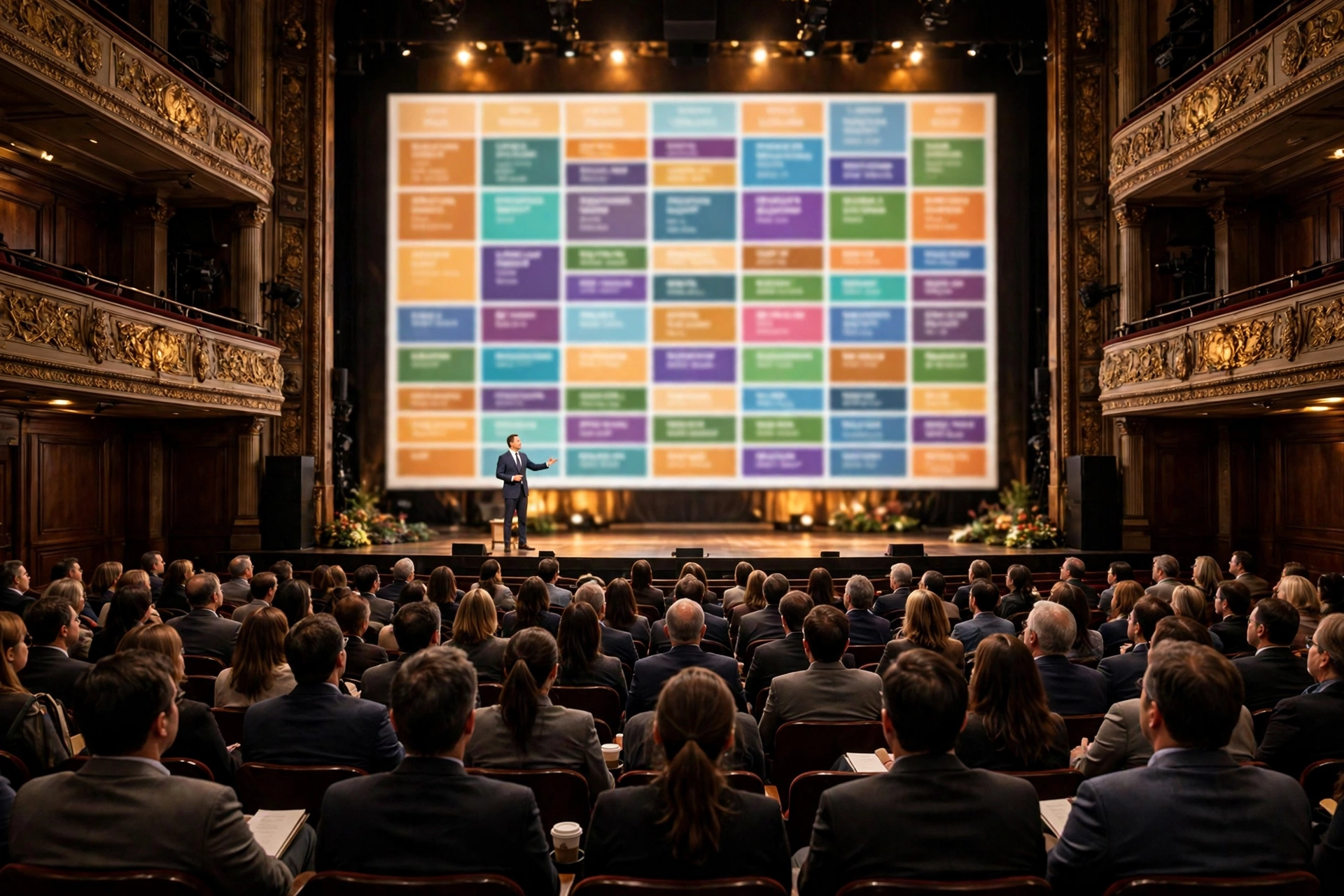
A fall schedule goes up on a screen in New York in May, and nobody in the room has seen a finished episode of half of it. Trailers, a returning hit's clip, a star walked out to applause — then the room empties and the real work starts in private, office by office, for weeks. By the time the new season premieres in the fall, most of the commercials that'll run inside it have already been sold. That's the upfront: not the presentation, but the advance sale the presentation opens.
Networks have historically sold 75 to 85 percent of a season's advertising inventory in that window. The buyer commits a volume of spending months before air. The seller commits to something more specific than a time slot, and that specificity is the whole machine.
The calendar runs backwards: May sells October
The broadcast year the deals cover runs primarily from October through the following September, a rhythm that traces to 1962, when ABC scheduled all its new shows to premiere in a single week after Labor Day and went looking for advertiser commitments the preceding spring. The clustering stuck. Shows launch in the fall, so the money has to move in May.
The presentations cluster in mid-May in New York — Disney, NBCUniversal, Fox and the rest staging their lineups within days of each other — and the negotiations that follow typically run 45 to 90 days past upfront week, through the summer. A network declares itself done with the upfront when it's sold the share of inventory it's willing to sell there. The rest stays in the vault for the second market, below.
The price is a rate per thousand people, locked in spring
An upfront deal doesn't price a show. It prices an audience. The unit is the CPM — the cost of reaching a thousand viewers — negotiated against a named audience segment, commonly adults 18 to 49, and locked at signing. The structure dates to 1967, when ABC cut the first guaranteed-CPM deal, with American Home Products: the advertiser paid for audience delivery at a fixed rate rather than buying specific programmes and carrying the ratings risk alone. Every network followed, and the risk moved.
What the buyer hands over in exchange is commitment: a total dollar figure, a mix of dayparts and programmes, and a year of spending agreed before a single rating exists for the new shows. What the buyer gets back is price protection. The same inventory, bought later, usually costs more — a point the ledger below prices.
The guarantee is the product, and shortfalls settle in ads, not cash
Each deal carries an audience guarantee: a floor, typically expressed in gross rating points, that the network must deliver against the buyer's money. If the season underdelivers — a new drama lands soft, a returning hit ages out — the network doesn't write a cheque. It pays in audience deficiency units, called ADUs or make-goods: additional commercial inventory, run elsewhere across the network's channels and streaming properties at no extra charge, until the promised audience has been delivered. A make-good isn't a penalty or a breach. It's the contract working as written, and a weak season can leave a network owing a large stack of them.
The guarantee rests on measurement, which is why the currency matters to both sides. Nielsen's combined system — a panel of more than 100,000 people merged with device-level data from roughly 45 million households — became the standard currency for the 2025 upfront negotiations, the numbers both sides argue from when they set the floor.
The buyer keeps an exit: cancellation options
A year-long commitment signed in May, against shows nobody's seen, would be a hard sell without a release valve, so the deals carry one. Cancellation options let a buyer cut a portion of the commitment at set windows before a quarter airs — commonly up to 50 percent of it, with trade accounts putting the typical range at 30 to 50 percent of a quarterly commitment, requested 30 to 60 days ahead. The streaming-only sellers run looser still: Amazon, Roku and YouTube generally sign "endeavor" deals built on spending goals rather than fixed commitments, and they typically let advertisers cancel up to 100 percent as late as 14 days before a campaign runs. Flexibility — the trades called it "fluidity" in the 2026 market — is where the old broadcast structure and the streaming structure are quietly converging.
What's left sells in the scatter market, at the season's real prices
The inventory a network holds back — roughly a fifth to a quarter of the total — sells in the scatter market, closer to air, priced against ratings that actually exist instead of projections. Scatter's the upfront's mirror: no year-long commitment, no locked rate, no guarantee. Per network and agency executives, scatter prices typically run 20 to 40 percent above upfront rates, and the gap can reach far higher in the fourth quarter, when holiday demand hits a fixed supply of slots. A network that sold most of its year in May walks into the season with a revenue floor it can plan against. Scatter's the upside — and the risk — priced one quarter at a time.
The ledger, upfront against scatter (the information gain in this piece — the comparison assembled in one place from the trade record):
- When it sells: upfront in May–summer, for October–September · scatter through the season, near air.
- What the price is: upfront, a CPM locked in spring · scatter, the going rate when the buy happens.
- What's guaranteed: upfront, an audience floor, settled in make-goods if missed · scatter, nothing beyond the slot itself.
- How a buyer exits: upfront, cancellation options up to roughly half a quarter's commitment, on notice · scatter, there's little to exit — no long commitment was made.
- Who carries the ratings risk: upfront, mostly the network, through the guarantee · scatter, the buyer, who pays the known number for a known audience.
The market now: streaming takes the larger half
The form ABC built for three broadcast networks now covers most of the video business. Media Dynamics, an advertising research firm, put total primetime upfront sales across broadcast, cable and streaming at approximately $33.8 billion for the 2026-27 season — streaming commitments at roughly $17.2 billion of it, broadcast at $8.63 billion, cable at about $8 billion, on the firm's own estimates. The digital counterpart has its own calendar: the IAB's NewFronts, formalized in the early 2010s, where streaming and digital sellers make the same spring pitch without the broadcast year's fixed shape.
Note what hasn't changed inside the expansion. The money still moves before the product exists as a finished thing, the price still rides on a promised audience, and a miss still settles in more advertising rather than money back. Sixty years on, the upfront remains a futures market wearing a fall schedule — and May is still when television finds out what the next year is worth. Our Nielsen explainer, linked below, takes apart the ratings number every one of these guarantees is written against.
Sources
- PPC Land, "Explaining upfront" — the advance-selling definition; presentations in New York in May followed by weeks of private negotiation; negotiations covering total commitment, the guaranteed segment (commonly adults 18 to 49), CPM and daypart mix; the guarantee in gross rating points; make-goods at no extra charge; cancellation options commonly up to 50 percent; networks historically selling 75 to 85 percent of annual inventory upfront; the 1962 ABC premiere week and the 1967 ABC–American Home Products first guaranteed-CPM deal; Media Dynamics' 2026-27 estimates (approximately $33.8 billion total primetime upfront sales, streaming roughly $17.2 billion, broadcast $8.63 billion, cable about $8 billion, the firm's own estimates); Nielsen's combined panel (more than 100,000 people) plus device data (roughly 45 million households) as the standard currency for the 2025 negotiations; the IAB NewFronts as the digital counterpart formalized in the early 2010s. https://ppc.land/upfront/ — opened in full.
- Digiday, "WTF is the TV upfront?" — the annual cycle running late spring through summer, wrapping by the end of August; commitments taking effect primarily in October and running through the following September, traced to the 1962 ABC origins; networks calculating deliverable audience and ad supply, then splitting it between upfront and scatter; traditional TV carrying up to 16 minutes of ads per hour; upfront prices typically 20 to 40 percent below scatter, and as much as 80 percent lower in the fourth quarter, per network and agency executives; shortfalls credited as audience deficiency units (ADUs / make-goods); cancellation options typically covering 30 to 50 percent of quarterly commitments on 30 to 60 days' notice; streaming-only sellers (Amazon, Roku, YouTube) signing endeavor deals and typically permitting cancellation of up to 100 percent up to 14 days before a campaign runs. https://digiday.com/future-of-tv/wtf-is-the-tv-upfront/ — opened in full.
- MediaVillage / MeetingPrep.ai, "About the Network TV Upfront Marketplace: A Primer" — the marketplace's 1960s origin; upfront week in mid-May with negotiations typically running 45 to 90 days after it; the September–August television season shape; deals negotiated on CPM, viewership, placements and budgets into upfront commitments for the coming season; ratings delivery guaranteed by networks with ADUs promised on underdelivery; upfront CPMs below scatter pricing. https://www.mediavillage.com/article/about-the-network-tv-upfront-marketplace-a-meetingprepai-primer/ — opened in full.

 Next in this issue · MusicRadio Airplay Charts Count Spins Detected by Listening Software, Station by Station. Here Is How a Play Becomes a Number. →
THE MOTHER LODE — Edition Nº 005 · Evening. Photos are real, licensed and credited on the page; designed cards carry figures from the article itself.