
Mercury Never Reverses in Its Orbit. Retrograde Is an Apparent Motion Seen From Earth, and an 88-Day Orbit Brings It Back Three or Four Times a Year
Mercury keeps moving forward on its orbit the whole time, and from Earth its path against the stars appears to slow, stop and run backward for roughly three weeks, three or four times a year. The astrological tradition reads those stretches as a prompt to review, revise and back things up — a mirror for an audit, never a sentence of fate.
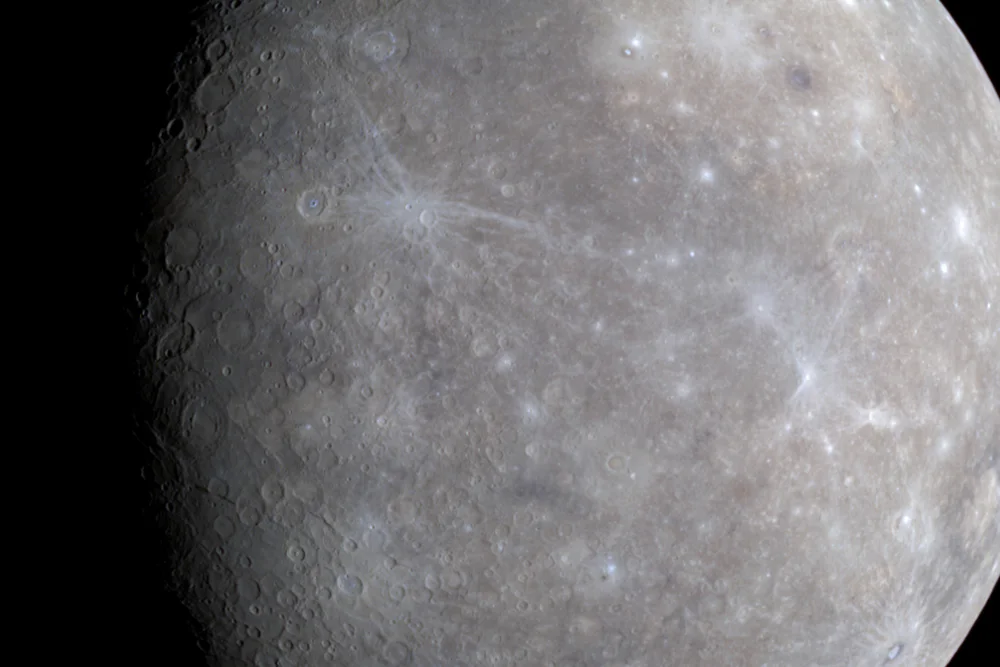
Somebody you love has already sent the warning. It'll arrive as a screenshot, a forwarded post, maybe a voice note with real concern in it: Mercury's in retrograde, so watch the contract, watch the flight, watch the phone. Here's the thing your friendly neighborhood astrologer will tell you before anybody else gets to you — Mercury didn't break your phone. Mercury hasn't touched your inbox, your boarding pass or your group chat. Something real does happen in the sky three or four times a year, and the sight of it has scared people for a very long time. But the planet's innocent. The view's guilty. Let's do the astronomy first, because the astronomy's better than the dread.
Mercury Keeps Moving Forward the Whole Time
NASA's StarChild explainer puts the whole correction in its first move: retrograde motion is an apparent change in a planet's movement through the sky. NASA's wording deserves the emphasis the agency gives it — the planet doesn't physically start moving backward in its orbit. Mercury appears to reverse because of the relative positions of Mercury and Earth and how both planets are moving around the Sun. Nothing up there throws a transmission into reverse. Nothing stalls, sulks or changes its mind.
The normal run of things has a name, too. Planets usually move west to east through the stars at night, and astronomers call that prograde motion. For a short stretch, the apparent motion flips and runs east to west instead — retrograde — and then the motion switches back to prograde and the episode closes. Read that sequence again and notice who owns every verb in it. The motion that flips is the apparent motion, the one measured from a platform — Earth — that's also moving. Mercury's own orbit never gets the memo, because no memo exists. The planet just keeps lapping the Sun the way the planet always has.
The Passing-Car Effect Belongs to Relative Motion
NASA teaches the effect with two walkers, and the classroom version still beats every mystic gloss on the subject. Stand side by side with a friend. Your friend walks forward slowly. You walk forward faster and overtake. Watch your friend as you pass, and your friend appears to drift backward relative to you — even though your friend never stopped walking forward. Nobody reversed. The relationship between two moving observers did all the work.
Swap the walkers for planets and give Mercury the inside lane. Mercury runs the closest orbit to the Sun and runs it fast — NASA clocks the planet at nearly 29 miles per second, faster than any other planet, on an egg-shaped orbit that carries it from 29 million miles out to 43 million miles from the Sun. Earth ambles along its wider track outside Mercury's. As Mercury rounds the near side of its orbit and sweeps across Earth's line of sight, the angle to the planet changes so quickly that Mercury's place among the background stars first stalls, then slides backward, then recovers its usual eastward run. You're watching a faster world cross your sightline from a moving platform of your own. The backward slide lives in the geometry, not in the planet.
An 88-Day Year Against a 365-Day Year Sets the Cadence
Frequency's where the dread should really die, because a rare omen can't keep a schedule this ordinary. NASA's Mercury page gives the planet's year in one short sentence: Mercury zips around the Sun every 88 Earth days. NASA's Kepler explainer sets Earth's year right beside it at 365 days. Divide 365 by 88 and Mercury fits a little more than four of its years inside one of ours.
Now run the lap math on those two periods. Mercury gains ground on Earth at a rate set by the difference between the two orbits, and the arithmetic lands the faster planet a full lap ahead roughly every 116 days. Three laps a year, give or take the calendar's edges, means three or four alignments a year with the geometry that produces the apparent reversal — and each reversal holds for roughly three weeks, while the sightlines swing through the passing zone and out the other side. A quarter of your year, roughly, carries the label people panic over. An omen with that kind of attendance record isn't an omen. It's a commute. Readers who enjoy watching orbital mechanics refuse to behave like magic can also try our explainer on why a space station falls around Earth forever without landing — a different orbit, the same lesson about trusting the geometry over the gut.
The Stations Mark Where the Apparent Motion Turns
Every retrograde episode has bookends, and the tradition and the astronomy share the vocabulary for once. As the passing geometry builds, Mercury's apparent motion against the stars slows. At the moment the apparent motion turns, the planet appears to hang still — a standstill called a station. The first one, where the eastward run gives way to the backward slide, is the station retrograde. Three weeks or so later, at the far end of the slide, comes the second standstill, the station direct, where the apparent motion turns again and Mercury resumes its prograde course across the stars.
Hold the definition tight, because sloppy talk about stations smuggles the fatalism back in. A station describes apparent motion only. Mercury's speed around the Sun carries on through both stations, governed by the same elliptical orbit NASA describes — faster near the Sun, slower farther out, never zero, never backward. The planet doesn't pause to gather menace. From Earth's moving deck, the planet's track across the fixed stars pauses. A viewpoint effect gets a viewpoint word, and the word's honest once you know whose eyes it describes.
The Shadow Covers the Same Degrees Three Times
Astrologers track Mercury's apparent path in degrees, and the shadow is the tradition's bookkeeping for a stretch of that path — bookkeeping first, meaning second. Here's how the ledger runs. Before the station retrograde, Mercury crosses a degree of its path and keeps moving forward. That crossing opens the pre-retrograde shadow. Mercury then stations, slides back across the same degrees in its apparent retrograde run, stations direct, and walks the same ground a third time in forward motion. The post-retrograde shadow closes only when Mercury passes the degree where the first station happened. One stretch of sky, covered three times: forward, back and forward again.
Notice what's actually being described. The shadow isn't a substance, a residue or a lingering influence, whatever the scariest accounts say. The shadow's a span of degrees with dates attached, drawn on the same apparent path the astronomy already explained. The tradition gave the retracing a name because the retracing repeats a theme in its readings — a subject gets visited, revisited and visited once more before the story moves on. You don't have to buy the reading to use the map. The map itself is just careful observation, kept in degrees.
The Tradition Reads the Stretch as a Time to Review
Now the tradition gets its say, in its own lane, with its name on its claims. In classical astrological tradition, Mercury governs messages, travel, trade, contracts and the instruments that carry them — letters in one century, inboxes in another. The tradition reads a retrograde stretch accordingly, as a period that favors the re- words: review the draft, revise the plan, recheck the figures, renew the acquaintance, repair the thing that's been limping. Today's practitioners add the plainest item on the list: back up the files. The tradition reads the stations as the moments to pay closest attention, and the shadow as the reason a subject may need three passes before it settles.
Mona's ruling on all of that, for the record: the reading's useful exactly as long as it stays a reading. A contract deserves a full reread before any signature, in every week of the year. A laptop backup counts as good practice on days when Mercury's doing nothing whatsoever. The tradition, at its best, hands you a calendar appointment with your own neglected paperwork and dresses the appointment in enough ceremony that you'll actually keep it. That's a mirror doing honest work. The trouble starts when the mirror gets promoted to an engine — when the stretch stops prompting the audit and starts causing the breakdown, excusing the sender and sentencing the week in advance. The tradition's oldest texts deserve better than that demotion, and so does your week.
Use the Transit as an Audit, Never as an Excuse
So here's the column's standing refusal, printed plainly so nobody has to guess. Mercury retrograde doesn't delay your flight, scramble your message or sour your negotiation, and this desk won't sell you manifestation, fate or a planet with a grudge. The transit's a mirror. A mirror shows you the state of your own house; a mirror never reaches out and rearranges the furniture. The moment a retrograde becomes the reason a hard email can't go out, a contract can't get a second reading or a mistake can't get owned out loud, the mirror has been swapped for an excuse — and excuses, unlike planets, really do move your life backward.
Run the audit instead. It's short, it's cheap and it works in every month on the calendar. Reread the contract aloud before you sign, and check the number you'd hate to have wrong. Confirm the meeting in writing, with the time zone attached. Back up the laptop tonight rather than someday. Leave for the airport with a margin you'd call excessive in a calmer week. Ask the second question in the negotiation, the one that feels too basic to ask. None of those moves works because a planet approves of it. Each one works because attention, applied on purpose, catches what haste misses. Do them under a retrograde sky if the sky's what reminds you. Do them under any sky at all. Mercury will keep its 88-day pace, the view from Earth will keep flipping three or four times a year, and the only thing in the whole arrangement with any power over your week is the person reading this sentence. That's you. It was always you.
Sources
- NASA StarChild, "What does it mean for Mercury to be in retrograde?," StarChild Question of the Month, June 2002 (NASA Goddard Space Flight Center / HEASARC) — retrograde motion defined as an apparent change in a planet's movement through the sky; the planet does not physically start moving backward in its orbit; the appearance comes from the relative positions of the planet and Earth and how they move around the Sun; prograde motion as the usual west-to-east run through the stars, retrograde as the east-to-west flip that continues for a short time before switching back; retrograde occurring roughly when a faster-moving planet catches up to and passes a slower one; the two-walkers passing demonstration. https://starchild.gsfc.nasa.gov/docs/StarChild/questions/question46.html — opened in full. No 2026 retrograde date ranges printed on this page.
- NASA Science, "Mercury: Facts" (updated April 25, 2025) — Mercury as the fastest planet, zipping around the Sun every 88 Earth days; the eccentric orbit from 29 million miles (47 million kilometers) to 43 million miles (70 million kilometers) from the Sun; speed of nearly 29 miles (47 kilometers) per second, faster than any other planet; one rotation every 59 Earth days; the solar day of 176 Earth days. https://science.nasa.gov/mercury/facts/ — opened in full. No 2026 retrograde date ranges printed on this page.
- NASA Science, "Orbits and Kepler's Laws" (updated October 28, 2024) — Kepler's three laws; planets moving in elliptical orbits with the Sun at a focus; a planet moving faster near the Sun and slower farther from it; Kepler's third law and its periods: Mercury, the innermost planet, takes only 88 days to orbit the Sun, Earth takes 365 days, Saturn 10,759 days. https://science.nasa.gov/solar-system/orbits-and-keplers-laws/ — opened in full. No 2026 retrograde date ranges printed on this page.
- Source note on dates: no 2026 retrograde date ranges are carried in this draft, because no page inside the NASA source fence opened in full this run prints them. The piece carries the cadence (three or four times a year, roughly three weeks at a time, a realignment roughly every 116 days by the lap arithmetic on NASA's 88-day and 365-day periods) and no calendar dates.
- Source note on terms: "station" and "shadow" are defined in the body as terms for the apparent path — a station as the point where the apparent motion appears to turn, the shadow as the stretch of degrees the apparent path covers three times. Astrological readings of those periods are labelled as the tradition's in the text, never stated as physical fact.

 Next in this issue · Books & ReadingCelebrity Book Clubs Pick Their Books One Reader at a Time, Then Bookstores Spend the Next Morning Catching Up →
Get the alert when it breaks.
When a story breaks on a beat you pick, we email or text you. When there's an emergency in your ZIP, we text you. Nothing else, and no ads in any of it.
Check your inbox — and your phone.
THE MOTHER LODE — Astrology · November 10, 2026. Photos are real, licensed and credited on the page; designed cards carry figures from the article itself.