
IMAX 70mm Film Runs Sideways Through the Projector at 15 Perforations a Frame. Here's Why That Makes the Picture Taller.
A 15/70 print is a physical object before it's a picture: hundreds of kilograms of film on a horizontal platter, fed sideways through the projector at 1.7 metres a second. The sideways feed is the whole design — it buys a frame three times the size of standard 70mm, and the frame's shape is the tall picture.
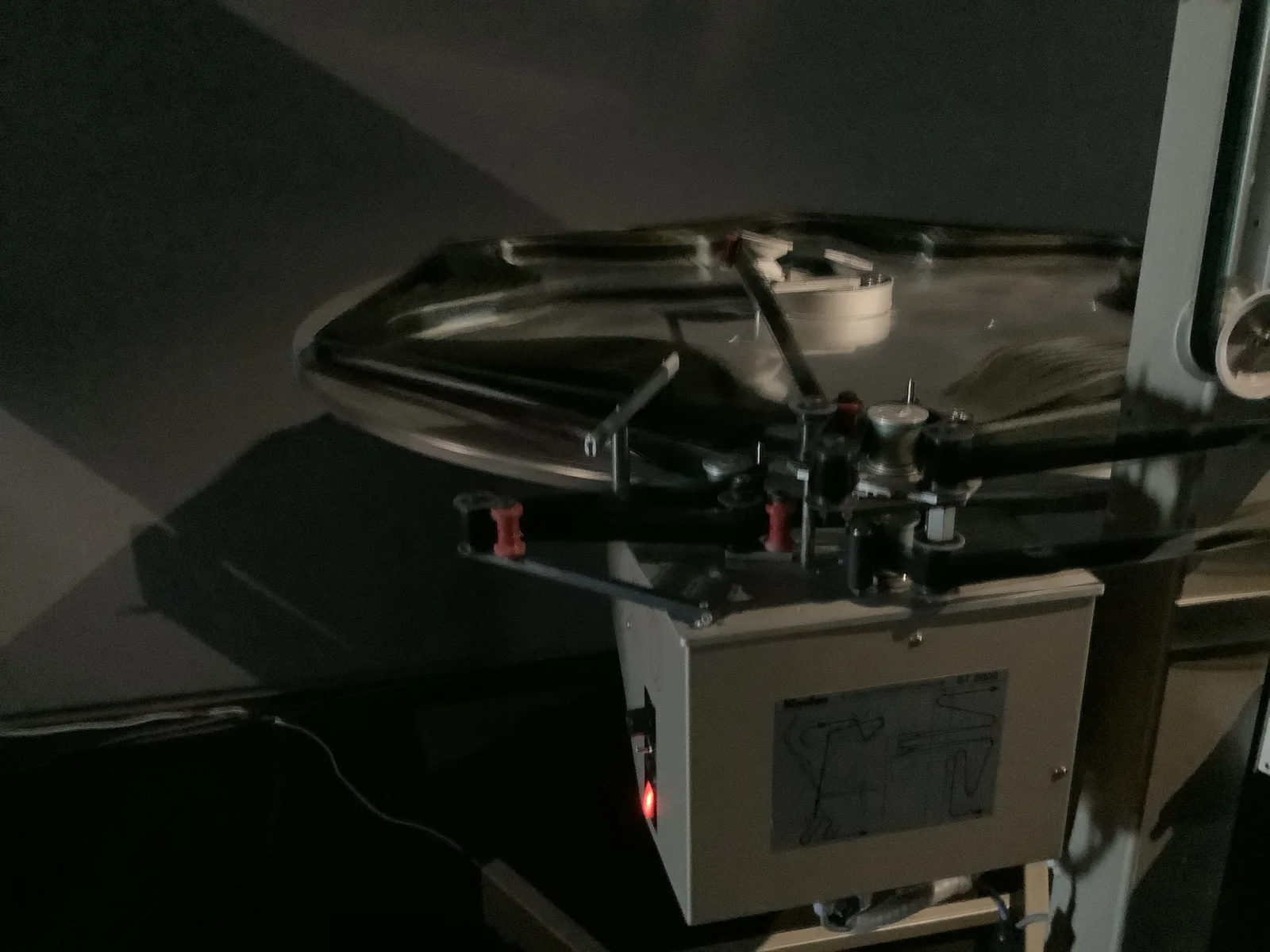
Start with the object, because the object explains the system. A 15/70 IMAX print of a feature film sits on a horizontal platter in the projection booth — a flat, wide disc of film, not a reel standing on edge. IMAX Melbourne's own numbers give the object its scale: the theatre's 180-minute print of "Oppenheimer" runs over 18 kilometres long, and its 163-minute print of "Interstellar" weighs over 270 kilograms. Nobody threads a print like that through a projector built for upright reels. The platter, the horizontal feed and the frame geometry all follow from the same decision: spend the film strip's length on the picture, not its width.
The Tool Blueprint: A Projector That Feeds Film Sideways
Conventional projectors pull film vertically, from a reel above the gate to a reel below it, and each frame stands across the strip's width. An IMAX 15/70 projector pulls film horizontally. The strip travels sideways through the gate, drawn off a horizontal platter, and each frame lies along the strip's length instead of across its width.
The transport has a name and a museum record. The Science Museum Group's collection record for its IMAX Rolling Loop Cine Projector — built by IMAX Corporation in Ontario in 1982, and used at the National Museum of Photography, Film and Television from 1983 to 1997 — describes the rolling-loop mechanism: the film advances around a rotor in a travelling loop, and a vacuum holds each frame flat against the aperture while the lamp illuminates it. The record gives the reason the loop exists in mechanical terms. A mechanism built for short vertical steps can't yank a frame three times as long into place 24 times a second without tearing the stock, so the film moves as a wave and settles, rather than jerking from stop to stop.
The speed is measurable and both records agree on it. IMAX Melbourne's page and the Science Museum Group's record each put the film's travel at 1.7 metres per second through the projector. Hold that number for the arithmetic below.
The Rule Book Is a Specification: 15 Perforations, 70 Millimetres, Horizontal
The format's name is its spec sheet. 15/70 means 15 perforations per frame on 70mm film. Perforations are the sprocket holes along the film's edge — the holes the transport grips to move the strip — and counting them measures a frame in the strip's own units.
Who runs the system: IMAX Corporation, which developed the format and builds the cameras and projectors to its proprietary specification — Britannica's format entry describes 15/70 as the company's proprietary film. Who decides what counts as the format: the specification itself, because a print either runs 15 perforations horizontally on 70mm stock or it's another format wearing the name. What a print costs in physical terms, per IMAX Melbourne's figures: kilometres of stock and hundreds of kilograms per feature, moved at 1.7 metres a second. And the test a frame has to pass is dimensional. Britannica's entry puts the usable image area at 69.6 millimetres by 48.5 millimetres — about 10 times the area of a standard 35mm frame, and thrice the area of a 5-perforation 70mm frame.
The camera side mirrors the projector side. Britannica's entry records that IMAX cameras shoot on 65mm negative, run horizontally through the camera the same way, and the negative is printed onto 70mm stock for projection, with the extra width carrying print information rather than picture. The frame a director composes in the camera and the frame an audience sees are the same sideways rectangle at both ends of the pipeline.
The Geometry: Turning the Strip Sideways Swaps Width for Height
Here's the mechanism, perforation by perforation. On a standard 70mm print — the 5/70 format — the film runs vertically, and each frame stands 5 perforations tall across the strip. The strip's 70mm width becomes the frame's width, the 5-perforation step becomes the frame's height, and the picture comes out wide and short: standard 70mm's shape. IMAX Melbourne's page puts the comparison in one line: standard 70mm carries just 5 perforations per frame, less than a third of the 15/70 frame's size.
Turn the same strip sideways and the dimensions trade jobs. The strip's 70mm width now becomes the frame's height. The frame's width stretches along the strip for 15 perforations — three times the 5-perforation step, 15 divided by 5. The frame that results measures 69.6mm wide against 48.5mm tall on Britannica's figures, and 69.6 divided by 48.5 is 1.43. That's the format's aspect ratio, 1.43:1 — width 1.43 units for every unit of height, against the mainstream cinema ratio of 2.39:1 that IMAX Melbourne's page uses as its comparison.
So the picture is taller for a literal reason. A 2.39:1 frame spends its area on width; a 1.43:1 frame keeps far more of its area in height. IMAX Melbourne's page converts the ratio into wall space: a full-frame 15/70 scene fills the entire 23-metre height of the theatre's screen, while a standard 2.39:1 presentation uses 13 metres of that same height. Same screen, same film width in the booth — 10 more metres of picture standing vertically, bought entirely by turning the strip on its side.
What the Name Doesn't Tell You
The omission deserves a line of its own. The word IMAX on a ticket doesn't certify any of the above. Britannica's entry records that most IMAX screens now run a wider 1.90:1 aspect ratio, on digital projection — no film, no platter, no 15 perforations anywhere in the booth. The 15/70 system survives in a small number of purpose-built theatres, IMAX Melbourne among them; the theatre's own page notes its film projector was installed in 1998, removed in 2015 to make room for a 4K laser system, kept in storage, and reinstalled in 2017 in time for "Dunkirk." A format a theatre can spend two years without is a format the brand name alone can't promise you.
A second omission rides with it. The resolution figures that circulate for 15/70 film — IMAX Melbourne's page reports figures of up to 16K as reported numbers — are estimates, not measurements. Britannica's entry states the point directly: the circulating figures are theoretical, and sharpness on analog film depends on lenses, development and camera operation rather than a pixel grid. The frame's size is a fact you can measure with a ruler. A "K" number for that frame is an argument, and this piece doesn't print arguments as specifications.
The Reader's Arithmetic: What 1.7 Metres a Second Adds Up To
Do the film-length sum out loud, from the theatre's own rate. At 1.7 metres per second, a minute of film consumes 1.7 times 60 — 102 metres. A 180-minute feature consumes 102 times 180 — 18,360 metres, or just over 18 kilometres. IMAX Melbourne's page states its "Oppenheimer" print at over 18 kilometres long. The theatre's two published numbers check against each other, which is how a reader can tell the figures describe the same machine.
Run the frame sum alongside it. At 24 frames per second, the 180 minutes of that print carry 24 times 60 times 180 frames — 259,200 frames, each one 15 perforations long, each one held flat by vacuum for its fraction of a second in the gate. And the weight follows the length: the theatre puts the shorter "Interstellar" print — 163 minutes — at over 270 kilograms. Length, weight and speed are the format's real running costs, and all three scale with the decision to make each frame three times as large.
From Expo Floor to Projection Booth: The Order of Events
The chronology is plain. IMAX Corporation's founders built the system in Canada in the late 1960s, and Britannica's entry dates the format's introduction to 1970, with the documentary short "Tiger Child" at Expo 70 in Osaka as the first film carrying 15/70 footage. The first permanent IMAX theatre followed in 1971, at Ontario Place Cinesphere in Toronto. The rolling-loop projector in the Science Museum Group's collection was built in 1982 and worked at Bradford's National Museum of Photography, Film and Television from 1983 to 1997. IMAX Melbourne installed its 70mm projector when the theatre opened in 1998, stored it through the laser conversion of 2015, and reinstalled it for "Dunkirk" in 2017.
I'd rather show you the render farm than call it a revolution — and on this desk the render farm is a platter of film running sideways at 1.7 metres a second, 15 perforations at a time, standing the picture up to a height no vertical strip can reach. For the other end of the frame-by-frame craft, our 4K restoration explainer follows a dying reel through the scan and the repair bench, and our AI video explainer counts the seconds the digital tools sell in place of all this stock.
Sources
- IMAX Melbourne, "IMAX 70MM FILM" — the IMAX theatre's own format page: 15/70 as 15 perforations in length by 70mm in height; standard 70mm at 5 perforations per frame, less than a third of the 15/70 frame's size; full-frame aspect ratio 1.43:1 (1.43 metres of width per metre of height) against the mainstream 2.39:1; a full-frame scene filling the screen's full 23-metre height against 13 metres for a 2.39:1 presentation; resolution of up to 16K described as often reported; film speed 1.7 metres per second; the 163-minute "Interstellar" print at over 270kg; the 180-minute "Oppenheimer" print at over 18km; the projector installed 1998, removed 2015 for the 4K laser system, retained in storage and reinstalled 2017 for "Dunkirk." https://imaxmelbourne.com.au/about_imax/imax-70mm-film — opened in full 2026-11-09.
- Encyclopaedia Britannica, "IMAX film format" — the proprietary 15/70 format running horizontally through the projector; the film strip's 70mm width dictating the frame's height; each frame spanning 15 perforations; usable image area 69.6mm × 48.5mm, about 10 times a standard 35mm frame and thrice a 5-perf 70mm frame; cameras shooting 65mm negatives horizontally, printed as positives onto 70mm prints, the print carrying no soundtrack; most IMAX screens now at 1.90:1; the resolution figures for film (10K, 16K, 18K) described as theoretical estimates; format introduced 1970, first permanent theatre at Ontario Place Cinesphere, Toronto, 1971; "Tiger Child" at Expo 70 as the first 15/70 film. https://www.britannica.com/technology/IMAX-film-format — opened in full 2026-11-09.
- Science Museum Group Collection, "IMAX Rolling Loop Cine Projector, 1982" — the collection record for the desk's named machine: manufactured by IMAX Corporation, Ontario, Canada, 1982; used at the National Museum of Photography, Film and Television from 1983 to 1997; 70mm film run through the projector horizontally, producing an area about 8.3 times the 35mm format and about 3.4 times 70mm run vertically, on the museum's measure; the rolling-loop transport, with loops of film held at the aperture by vacuum; the format referred to as 1570 — 70mm for the film size, 15 for the perforations per frame; film speed 1.7 metres per second. https://collection.sciencemuseumgroup.org.uk/objects/co8090394 — opened in full 2026-11-09.
- IMAX Corporation, imax.com — the company's own format/technology page couldn't be opened in this run (the technology URL returned a 404). No figure in this piece rests on an unopened imax.com page; the gap is recorded here per the honesty rule, and an opened imax.com format page is owed at the lineup gate as a fourth source.

 Next in this issue · HollywoodCalifornia Returns 35 Percent of a Production's Qualified Spending as a Tax Credit and Georgia Returns up to 30 Percent. Five Steps Move the Money From the Set to the Tax Return. →
Get the alert when it breaks.
When a story breaks on a beat you pick, we email or text you. When there's an emergency in your ZIP, we text you. Nothing else, and no ads in any of it.
Check your inbox — and your phone.
THE MOTHER LODE — Edition Nº 006 · Evening. Photos are real, licensed and credited on the page; designed cards carry figures from the article itself.